
Antifragility and Mental Health
Modern life often feels uncertain, fast moving, and psychologically demanding. Careers shift unexpectedly, relationships change, economies fluctuate, and social pressures can weigh heavily on the mind. In such a world, many people aim simply to cope or survive. Yet there is a deeper and more empowering approach available: antifragility.
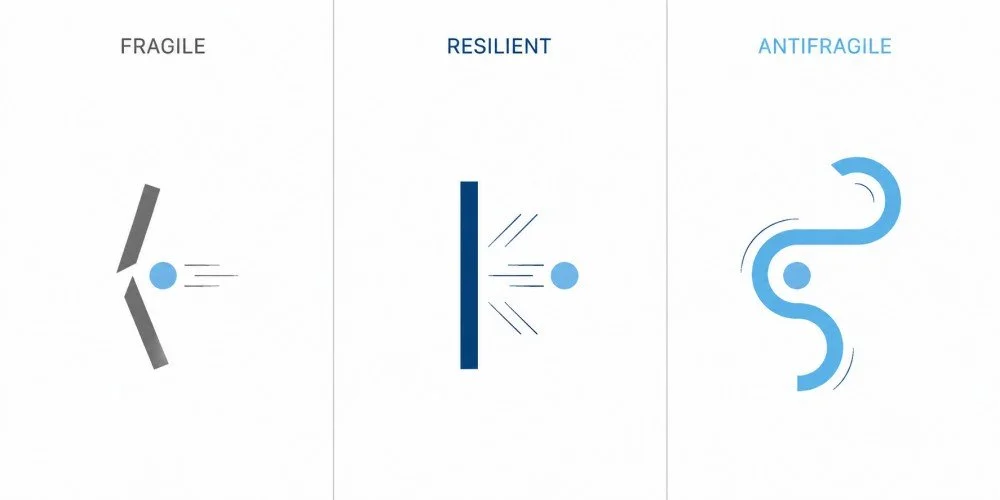
Antifragility is more than resilience. It is the capacity to grow stronger through stress, challenge, uncertainty, and disorder.
As a life ethos, it can profoundly transform mental health by helping individuals develop meaning, adaptability, confidence, and inner strength.
What Antifragility Is
The concept of antifragility became widely known through Professor Nassim Nicholas Taleb. It describes systems or people that benefit from shocks rather than merely endure them.
To understand it clearly, it helps to compare three states:
Fragile
When a person is easily overwhelmed by stress. Setbacks may shatter confidence, create avoidance, or lead to emotional collapse. Their wellbeing depends heavily on conditions staying comfortable and predictable.
Resilient
When a person can withstand pressure and recover after hardship i.e. they bend without breaking. This is valuable, but resilience often means returning to the previous state.
Antifragile
When a person uses adversity as fuel for development. Difficulty becomes training, loss becomes wisdom, failure becomes information and pressure becomes an opportunity to refine character and capability.
This does not mean pain feels pleasant or that suffering should be romanticised. It means challenge can become constructive when approached wisely.
Why Anti Fragility Matters in the Modern World
Many traditional forms of stability have weakened. People can no longer assume one lifelong career, one predictable path, or one stable social identity. Technology is evolving rapidly and economic systems are changing quickly, and whilst social media intensifies comparison and insecurity, unexpected disruption has become the norm.
In this environment, relying on certainty can damage mental health. If someone needs life to remain controlled in order to feel safe, anxiety often increases. Every change feels threatening.
Antifragility offers a healthier and practical alternative. Instead of asking life to stop changing, it trains the self to become stronger through change. This shift reduces fear and builds psychological flexibility.
Mental health often suffers when people interpret uncertainty as danger. Yet uncertainty can also be interpreted as possibility, growth, and new direction. Antifragility invites this second lens.
Rather than seeing chaos as only destructive, the antifragile mindset recognises that disorder often contains hidden opportunities. Many people discover their strengths only because life challenged them.
How Anti Fragility Fosters Constant Growth and Evolution
One of the greatest psychological benefits of antifragility is that it turns life into a learning process rather than a pass fail test.
A fragile mindset may think:
“If I fail, I am inadequate.”
An anti fragile mindset thinks:
“If I fail, I have gained data.”
This difference is enormous.
When mistakes become information, shame decreases, when rejection becomes redirection, despair softens and when discomfort becomes training, fear loses some of its power.
Growth then becomes continuous and every experience can teach:
Conflict can teach communication.
Heartbreak can teach discernment.
Loss can teach gratitude.
Stress can teach boundaries.
Uncertainty can teach faith and adaptability.
This mindset supports mental wellbeing because it reduces stagnation, as many emotional struggles worsen when people feel trapped or powerless. Antifragility restores agency by asking, “How can this strengthen me?”
It also builds self-trust - each time someone survives difficulty and extracts wisdom, they gather evidence that they can face future challenges.
Life Happens for You, Not to You
One of the most transformative perspectives linked to anti fragility is the idea that life happens for you, not to you.
This does not mean every painful event is good or that injustice should be excused. It means that even painful events can become material for growth, awakening, and deeper wisdom.
The victim mindset often asks:
“Why is this happening to me?”
The anti fragile mindset asks:
“What is this asking me to learn, change, release, or become?”
That question changes everything.
When life is seen only as something that happens to us, we feel passive and helpless. When life is also something that happens for our development, we regain participation in our own story.
A job loss may reveal misalignment.
A breakup may reveal unmet needs or patterns.
Burnout may reveal neglected values.
Failure may reveal where growth is required.
This perspective can significantly support mental health because meaning reduces suffering. Pain without meaning often feels unbearable and pain with meaning becomes a transformative experience.
Many therapeutic approaches recognise this principle indirectly. Healing often begins when a person can integrate hardship into a meaningful narrative rather than seeing themselves only as damaged by it.
How to Become Anti Fragile
Antifragility is not a personality trait reserved for a few people. It can be cultivated through practice.
1. Reframe Adversity
When difficulties arise, pause and ask:
What might this teach me?
How could this strengthen me?
What capacity is being developed here?
This does not deny pain. It adds purpose to pain.
2. Build Stress in Healthy Doses
Humans grow through manageable challenge, avoiding all discomfort creates fragility.
Examples include:
Having difficult conversations
Learning new skills
Exercising regularly
Setting boundaries
Taking thoughtful risks
Small voluntary discomfort builds confidence for larger involuntary discomfort.
3. Detach Identity from Outcomes
Failure hurts more when people fuse identity with results.
Instead of,
“I failed, therefore I am a failure”
shift to:
“That attempt failed. I am learning.”
This preserves self-worth while allowing honest growth.
4. Reflect and Extract Lessons
After setbacks, journal or contemplate:
What happened?
What was in my control?
What patterns do I see?
What wisdom can I carry forward?
Experience alone does not guarantee growth. Reflected experience does.
5. Develop Multiple Sources of Meaning
Fragility increases when wellbeing depends on one thing only, such as one relationship, one job, or one identity.
Cultivate varied anchors:
Friendship
Purpose
Health
Service
Creativity
Spirituality
Learning
Diversified meaning creates emotional strength.
6. Care for the Nervous System
Antifragility is not endless toughness - Growth requires recovery too.
Sleep, movement, rest, mindfulness, nature, therapy, and supportive relationships help the mind process stress constructively rather than destructively.
7. Choose Courage Repeatedly
Antifragility grows through repeated acts of courage, often small ones.
Speaking honestly.
Trying again.
Beginning anew.
Leaving what harms you.
Trusting yourself.
Each act tells the psyche: “I can meet life.”
Final Thoughts
Mental health is not only the absence of suffering. It is also the presence of meaning, adaptability, self-trust, and inner vitality.
Antifragility offers a powerful life ethos for cultivating these qualities. Instead of merely surviving hardship, we can learn to be shaped by it in wise and strengthening ways.
The storms of life may still come. But with an antifragile mindset, storms do not only threaten to break us. They can provide an opportunity for growth.
If you’ve been experiencing some challenges at work that resonate with what’s been described in this article, but would like some more clarity on what’s been happening for you. Download the free Burnout & Disillusionment assessment tool by clicking on the button below - it only takes about 20 minutes.
If you feel ready to address whichever challenge you’re facing and would like more direct 1:1 support and would like to know what support I could offer or what working with me looks like, without any pressure or locked in commitments, you can book afree 20 minute call by clicking on the prompt below.