Dialectical Thinking and Mental Health in a World of Change and Contradiction
Modern life often pressures us toward certainty, perfection, and fixed identities. We are encouraged to build the “ideal life,” work at the “ideal company,” have the “ideal relationship” or achieve an image of flawless wellbeing. When life inevitably fails to conform to these ideals, distress can emerge. Anxiety, shame, rigidity, hopelessness, and chronic self-criticism often grow in the gap between lived reality and imagined perfection.
Dialectical thinking offers a different way of understanding ourselves and the world. Rather than viewing truth as something static, pure, or absolute, dialectical thought understands reality as dynamic, relational, and constantly evolving. It sees life as a process of movement through tensions, contradictions, and transformation.
This perspective can be deeply supportive for mental health.
What is Dialectical Thinking?
Dialectical thinking is a way of understanding reality through change, contradiction, and development. It proposes that life is not fixed but constantly in flux. Things evolve through interaction between opposing forces or tendencies.
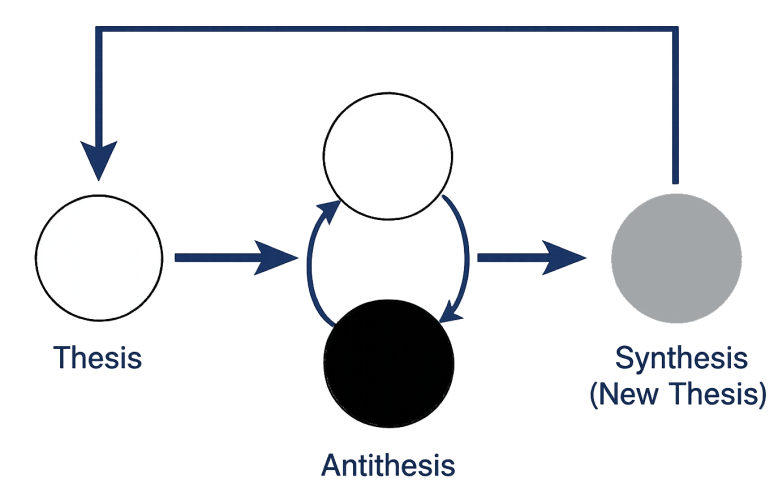
A simplified way this is often expressed is through the movement of:
Thesis: an existing position, state, or condition.
Antithesis: an opposing force, contradiction, or challenge.
Synthesis: a new outcome emerging from the engagement between the two.
Importantly, synthesis is not merely compromise. It is transformation. Something new emerges that incorporates and transcends what came before.
Dialectical thinking can be found in philosophy, psychology, spirituality, systems theory, and even ecological understandings of life. Nature itself appears dialectical, growth and decay coexist, stability and disruption interact and destruction often creates conditions for renewal.
Human psychology is no different.
We are rarely one thing or another. We are complex, contradictory, unfinished beings constantly shaped by experience, context, conflict, and development.
When we stop fighting this reality and begin working with it, we may experience improvements in mental health.
The Psychological Burden of Static Thinking
Many forms of emotional suffering are intensified by rigid, binary, or idealised thinking.
Consider thoughts such as:
“I must always be strong.”
“If I am anxious, I am failing.”
“A healthy relationship should not involve conflict.”
“If I cannot achieve my ideal self, I am inadequate.”
These beliefs treat truth as something pure, fixed, and uncontaminated by contradiction.
Strength must exclude vulnerability.
Love must exclude conflict.
Self-worth must exclude imperfection.
Healing must exclude setbacks.
But life (even human life) does not operate this way.
When our minds cling to static ideals, reality continually appears as failure. Because reality is messy, changing, contradictory, and incomplete, idealised frameworks often produce chronic disappointment.
This can contribute to:
• Perfectionism
• Anxiety
• Depression
• Shame
• Identity rigidity
• Obsessive self monitoring
• Fear of uncertainty
• Emotional suppression
Mental suffering is not always caused by pain itself. Often, suffering intensifies through resistance to the imperfect, contradictory nature of being human.
Dialectical thinking loosens this resistance.
Accepting Contradiction as Part of Mental Health
One of the most psychologically liberating aspects of dialectical thinking is its recognition that opposites can coexist.
- You can be healing and still struggling.
- You can love someone and feel angry with them.
- You can be confident in some areas of life and deeply uncertain in others.
- You can move forward while grieving what was lost.
These realities do not necessarily represent inconsistency or failure - they reflect complexity.
Many people experience distress because they believe contradictory experiences invalidate each other.
“I feel grateful, so I shouldn’t feel sad.”
“I chose this path, so I shouldn’t doubt myself.”
“I am improving, so I shouldn’t be having difficult days.”
Dialectical thinking invites a broader frame where both experiences may be true simultaneously.
This shift can reduce internal conflict. Rather than forcing emotional experiences into rigid categories of right versus wrong, healthy versus unhealthy, successful versus failed, individuals can develop greater psychological flexibility.
This is one reason dialectical approaches have influenced therapeutic work.
For instance, Marsha Linehan developed Dialectical Behavior Therapy around the integration of seemingly opposing truths, particularly acceptance and change.
The core insight is profound:
You can accept yourself as you are and work toward change at the same time.
Without dialectical thinking, these goals can appear mutually exclusive.
With dialectical thinking, they become complementary.
Life in Flux: Why Change is Central to Psychological Wellbeing
Mental health difficulties are often intensified by attempts to freeze reality. We may cling to identities, relationships, expectations, or versions of ourselves that no longer fit who we are becoming. Dialectical thinking reminds us that change is not an exception to life. Change is the condition of life. This perspective can be psychologically protective.
When we understand ourselves as evolving processes rather than fixed entities, difficult experiences become more workable.
A depressive period is no longer necessarily “who I am forever.”
A crisis is no longer definitive proof of permanent brokenness.
A painful ending is no longer the end of meaning itself.
Instead, experiences become moments within an unfolding developmental process. This does not trivialise suffering. Pain remains real and loss remains painful. But dialectical thinking situates suffering within movement rather than permanence.
There is room for emergence.
There is room for becoming.
There is room for outcomes not yet visible.
This orientation can nurture hope, not as blind optimism, but as recognition that reality is dynamic.
The Problem with “Purity” and Ideals as Sources of Truth
A powerful but often hidden contributor to mental health struggles lies in the pursuit of purity.
Purity based thinking assumes truth exists in flawless forms, uncontaminated categories, or ideal states.
• The pure self.
• The pure relationship.
• The pure moral position.
• The pure identity.
• The perfectly regulated mind.
At first glance, ideals can seem motivating, they can provide direction, aspiration, and meaning. The problem emerges when ideals become rigid standards against which all reality is judged - purity thinking tends to divide life into binaries or dualities:
• Pure or corrupted
• Good or bad
• Worthy or unworthy
• Successful or failed
• Healthy or damaged
This binary/dualistic framework often leaves little room for ambiguity, nuance, contradiction, or growth - psychologically, this can be dangerous as perfectionism frequently operates through purity logic. So can moral scrupulosity, harsh self judgement, relational idealisation, and forms of obsessive thinking.
People may feel trapped trying to preserve impossible standards of emotional, moral, bodily, professional, or relational perfection, and when inevitable imperfections appear, shame often follows.
Using dialectical thought, truth is not found in static purity detached from reality. Itemerges through engagement with reality’s complexity, contradiction, and movement. Human beings are not purified essences to be perfected - we are living processes.
We are shaped through tension, struggle, adaptation, reflection, connection, and change.
From a dialectical perspective, imperfection is not necessarily a deviation from truth. It may be one of the ways truth unfolds.
Dialectical Thinking and Self Compassion
Dialectical thinking opens perspective which naturally leads to deeper self-compassion.
When you no longer expect yourself to embody a pure ideal, you can relate to your humanity differently.
Instead of asking:
“Why am I not perfectly healed?”
you may ask:
“What tensions am I navigating in this stage of my development?”
Instead of:
“Why am I still struggling?”
you may ask:
“What contradictions am I learning to hold?”
This does not lower standards or abandon responsibility, rather, it creates a more realistic, humane framework for growth. Growth becomes less about eliminating contradiction and more about engaging with it creatively.
Mental health then shifts from achieving permanent equilibrium to developing a flexible capacity to move with life’s changing conditions.
Towards a More Dialectical Relationship with Ourselves and Life
To think dialectically is not merely to adopt a philosophical theory - it is to cultivate a different relationship with existence.
It means recognising that certainty is limited, identities evolve, opposites coexist, and development often emerges from tension rather than purity.
This orientation can soften perfectionism, reduce rigid self judgement, and create greater tolerance for uncertainty and complexity.
You do not need to become a flawless version of yourself to be psychologically whole.
You do not need to eliminate every contradiction to be authentic.
You do not need life to conform to ideal forms for meaning, truth, or wellbeing to exist.
Mental health may depend, in part, on our willingness to understand ourselves not as fixed objects striving toward impossible purity, but as dynamic beings in an ongoing process of becoming.
And perhaps there is something subtly relieving in that.
Not the pressure to finally arrive at perfection.
But permission to participate in the unfinished, contradictory, evolving reality of being human and participating in life.
If you’ve been experiencing some challenges at work that resonate with what’s been described in this article, but would like some more clarity on what’s been happening for you. Download the free Burnout & Disillusionment assessment tool by clicking on the button below - it only takes about 20 minutes.
If you feel ready to address whichever challenge you’re facing and would like more direct 1:1 support and would like to know what support I could offer or what working with me looks like, without any pressure or locked in commitments, you can book afree 20 minute call by clicking on the prompt below.